How to Choose the Right Business Entity in Pakistan
Choosing the right business entity is one of the most consequential decisions an entrepreneur makes. The structure you select on day one affects your personal liability, tax obligations, ability to raise capital, and even your exit options years down the line.
In Pakistan, the Securities and Exchange Commission of Pakistan (SECP) governs business registration and offers several entity types. Each has distinct advantages and trade-offs. This guide walks through the options so you can make an informed choice.
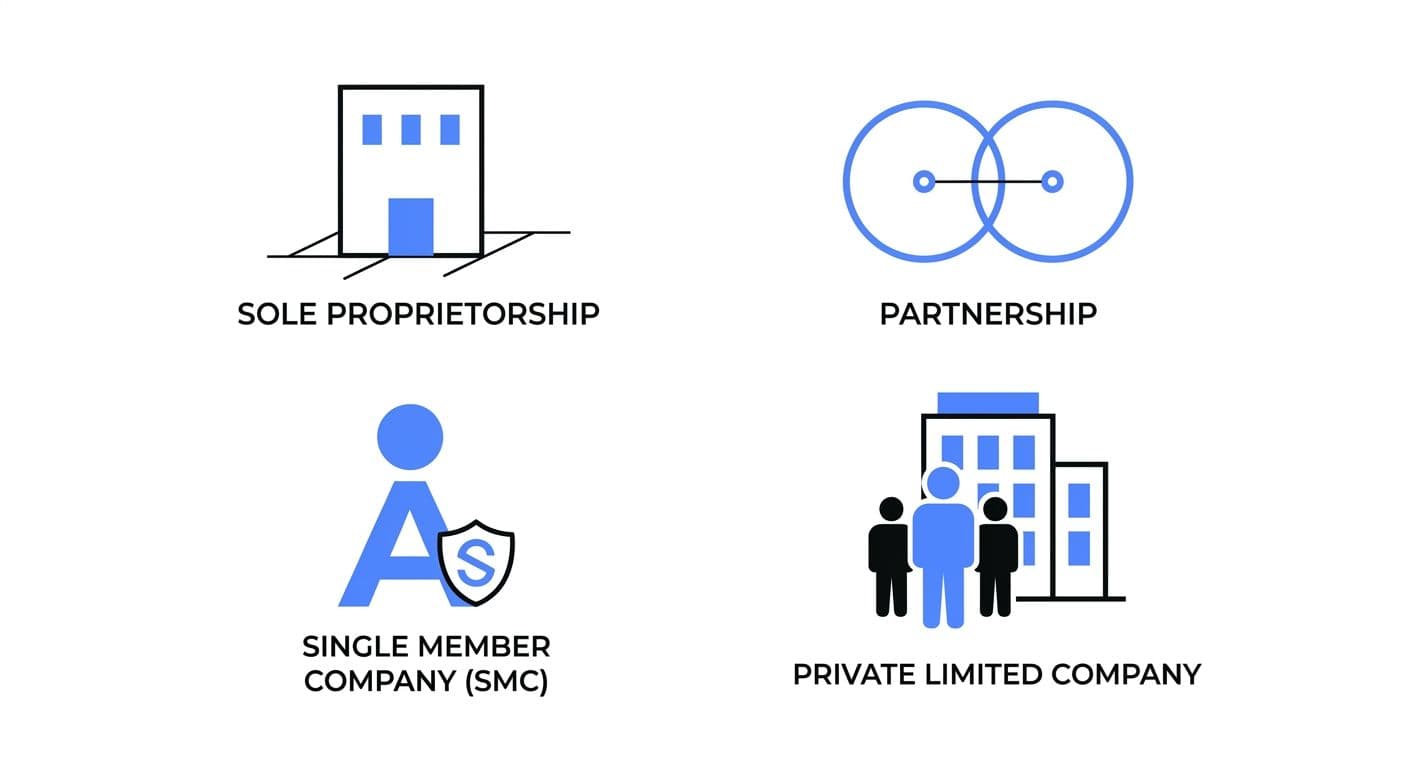
Sole Proprietorship
The simplest and most common business structure. The owner and the business are legally the same entity. Registration is minimal — a National Tax Number (NTN) from FBR is the primary requirement.
Best for: Freelancers, small retailers, consultants, and service providers testing a business idea.
Pros: Minimal compliance, full control, lowest cost to establish and maintain.
Cons: Unlimited personal liability — creditors can go after your personal assets. Difficulty raising capital from formal sources.
Partnership (Association of Persons)
Two or more individuals share ownership, profits, and liabilities. A partnership deed outlines the terms. Partnerships can be registered or unregistered, though registration provides legal benefits.
Best for: Professional practices (law firms, accounting firms), family businesses, small teams.
Pros: Shared capital and expertise, relatively simple setup, pass-through taxation.
Cons: Unlimited joint liability, potential for disputes, difficulty transferring ownership.
Single Member Company
Introduced under the Companies Act 2017, this structure gives solo entrepreneurs the liability protection of a private limited company without requiring a second shareholder.
Best for: Solo founders who want liability protection and credibility but do not have a co-founder.
Pros: Limited liability, separate legal entity, easier to convert to a full private limited company later.
Cons: More compliance than sole proprietorship, annual SECP filings required, higher setup cost.
Private Limited Company
The preferred choice for serious businesses. A private limited company is a separate legal entity with limited liability, perpetual succession, and the ability to issue shares. Minimum 2 directors and 2 shareholders are required.
Best for: Growing businesses seeking investment, companies with multiple founders, businesses requiring significant bank financing, and any operation where liability protection is critical.
Pros: Limited liability, easier access to funding, perpetual existence, enhanced credibility with clients and partners, easier to sell or transfer.
Cons: Higher compliance burden (annual SECP filings, audited financial statements above certain thresholds), higher setup and maintenance costs.
How to Decide: A Decision Framework
Ask yourself these questions:
- Do you need liability protection? If personal asset protection matters, choose a company structure.
- Do you plan to raise outside investment? Private limited company is essentially the only option investors consider.
- What is your risk profile? High-risk industries (construction, manufacturing, import/export) should always incorporate.
- How many founders? Solo = Single Member Company or Pvt Ltd with nominees. Multiple = Partnership or Pvt Ltd.
- What is your budget for compliance? Sole proprietorships cost almost nothing. Private limited companies require professional support for annual filings.
The SECP Registration Process
Once you have chosen your entity type, registration with SECP is completed through the e-Services portal. The typical process takes 2–4 weeks and includes name reservation, document submission, fee payment, and issuance of the Certificate of Incorporation. After incorporation, registration with FBR for NTN and sales tax is the next step.
How Uzair Khalid & Co Can Help
We advise clients on entity selection, manage the full SECP registration process, and handle post-incorporation compliance including NTN registration, sales tax registration, and ongoing secretarial support. Our team ensures your business starts on the right legal and tax foundation.
Contact us to discuss which structure is right for your business.